Monday, 2 July 2018

How to Rock MozCon 2018 Like the Marketing Superhero You Are

Posted by FeliciaCrawford

MozCon is just around the corner, meaning it’s time to share one of our absolute favorite posts of the year: the semi-official MozCon Guide to Seattle!

For those of you following the yellow brick road of I-5 into the heart of the Emerald City to spend three days absorbing all the SEO insight you can hold, this should help you plan both how you spend your time at the conference and outside of it. For those watching on the sidelines, scroll along and you’ll find a treasure trove of fun Seattle ideas and resources for future cons or trips you might make to this fair city by the sea.

Update as of June 28th: We"ve sold out! But if you missed out on getting a ticket and are feeling mopey about MozCon 2018, you can join our waitlist:

Sign up for the waitlist

Official MozCon activities:

We know you’re here for a conference, but that’s only part of your day. After you’ve stuffed every inch of space in your brain with cutting-edge SEO insights, you’re going to want to give yourself a break — and that’s exactly why we’ve put together an assortment of events, activities, suggestions, and Seattle insider pro tips for how to fill your time outside of MozCon.

The MozCon kickoff party!

With day one behind you, we’re guessing you’ll be some mix of energized, inspired, and ready to relax just a bit. Celebrate the first day of MozCon at our Monday night kickoff party with a night of networking, custom cocktails, and good music at beautiful Block 41 in Belltown.

Meet with fellow marketers and the Mozzers that keep your SEO software shiny while you unwind after your first full day of conferencing. It’s our privilege and delight to bring our community together on this special night.

Our famously fun MozCon Bash

There ain’t no party like a MozCon party! We invite all MozCon attendees and Mozzers to join us on Wednesday night at the Garage Billiards in Seattle’s Capitol Hill neighborhood. From karaoke to photobooth, from billiards to shuffleboard, and peppered liberally with snacks and libations, the Wednesday Night MozCon Bash is designed to celebrate the completion of three days of jam-packed learning. This is the industry party of the year — you won’t want to miss it!

Birds of a Feather lunch tables

In between bites of the most delicious lunch you’ll find in the conference circuit, you’ll have the opportunity to connect with your fellow community members around the professional topics that matter most to you. Each day there will be seven-plus tables with different topics and facilitators; find one with a sign noting the topic and join the conversation to share advice, learn new tips and tricks, and discover new friends with similar interests.

Monday, July 9th

  • Google Analytics & Tag Management hosted by Ruth Burr Reedy at UpBuild
  • Content-Driven Link Building hosted by Paddy Moogan at Aira
  • Mobile App Growth hosted by Emily Grossman at Skyscanner
  • Content Marketing hosted by Casie Gillette at KoMarketing
  • Local SEO hosted by Mike Ramsey at Nifty Marketing
  • Podcasting hosted by Heidi Noonan-Mejicanos at Moz
  • Workflow Optimization hosted by Juan Parra at Accelo

Tuesday, July 10th

  • SEO A/B Testing hosted by Will Critchlow at Distilled
  • Community Speaker Connection hosted by Sha Menz at Moz
  • PPC + SEO Integration hosted by Jonathon Emery at Distilled
  • Meet Your Help Team hosted by Kristina Keyser at Moz
  • Agency Collaboration hosted by Yosef Silver at Fusion Inbound
  • Site Speed hosted by Jono Alderson at Yoast
  • Featured Snippets hosted by Rob Bucci at STAT Search Analytics
  • Voice Search hosted by Dr. Pete Meyers at Moz

Wednesday, July 11th

  • Content Marketing Q&A hosted by Kane Jamison at Content Harmony
  • Paid Search Marketing for High-Cost Keywords hosted by Trenton Greener at the Apex Training
  • SEO A/B Testing hosted by Will Critchlow at Distilled
  • Team Hiring, Retention, & Growth hosted by Heather Physioc at VML
  • Local Search hosted by Darren Shaw at Whitespark
  • Machine Learning & Advanced SEO by Britney Muller at Moz
  • Reporting Q&A hosted by Dana DiTomaso at Kick Point

The delight is in the details

MozCon is literally brimming with things to do and ways to support our attendees when they need it. Aside from our hosted events and three days’ worth of talks, we’ve got things to fill in the cracks and make sure your MozCon experience is everything you’ve ever wanted from a conference.

Photobooth with Roger: Admit it — you see that cute, googly-eyed robot face and you just want to hug it forever. At MozCon, you can do just that — and memorialize the moment with a picture at the photobooth! Roger’s a busy bot, but his photobooth schedule will be posted so you can plan your hugs accordingly.

Ping pong play sesh: Don your sweat bands and knee-high socks and keep your paddle arm limber! During breaks, we’ll have ping pong tables available to burn some excess energy and invite a little casual competition.

The world map of MozCon: Ever play pin the tail on the donkey? Well, this is sort of like that, but the donkey is a world map and (thankfully) there’s no blindfold. You’ll place a pin from wherever in the world you traveled from. It’s amazing to see how far some folks come for the conference!

Local snacks galore: Starbucks, Piroshky Piroshky, Ellenos Yogurt, and Top Pot Donuts will happily make themselves acquainted with your tastebuds! Carefully chosen from local Seattle businesses, our snacks will definitely please your local taste palate and, if past feedback is to be believed, possibly tempt you to move here.

Stay charged: Pining for power? Panicking at that battery level of 15% at 10am? Find our charging sofas to fuel up your mobile device.

MozCon is for everyone

We want marketers of all stripes to feel comfortable and supported at our conference. Being “for everyone” means we’re working hard to make MozCon more accessible in many different ways. The Washington State Convention Center is fully ADA compliant, as are our other networking event venues. But it’s important for us to get even better, and we welcome your feedback and ideas.

Here are a few of the ways we’ve worked to make MozCon a welcoming event for everyone:

  • A ramp on the stage
  • Live closed captioning of the main event
  • Walkways for traffic flow
  • Menus featuring options or special meals (that actually taste good) for dietary restrictions
  • A nursing room
  • Gender-neutral bathroom options
  • Lots of signage
  • T-shirts that fit different body types
  • Visible staff to help make everyone’s experience the best possible
  • A proud partnership with 50/50 Pledge, furthering our commitment to better representation of women on stage
  • Strict enforcement of our Code of Conduct and TAGFEE

Bespoke city exploration — Get to know Seattle!

In years past, Tuesday nights were reserved for our MozCon Ignite event, where brave folks from myriad backgrounds would share stories in lighting-fast Ignite-style talks of five minutes each — the only rule being it can’t be about marketing!

While MozCon Ignite has always been a much-loved and highly anticipated event, we’ve also listened closely to your feedback about wanting more time to network on your own, plan client dinners, go on outings with your team, and in general just catch your breath — without missing a thing. That’s why this year, we’re folding Ignite into the official MozCon schedule so everyone can benefit from the tales shared and enjoy a fun five-minute break between SEO talks.

Wondering about what topics will be covered at Ignite this year?:

  • The Ninja Kit to NOT Get Sick While Traveling by Dana Weber at Seer Interactive
  • My Everest: How 10 Years of Chasing Tornadoes Came Down to One Moment by Tom Romero at Uncommon Goods
  • Baseball Made Me a Better Engineer by Tom Layson at Moz
  • Trailblazer: How Reading One Book Changed My Life for Good by Lina Soliman at OSUWMC
  • Drag Queen Warlocks, Skateboarding Sorcerers, & Other Folks by Jay Ricciardi at Tableau
  • Voice Dialogue Therapy: Listening to the Voices Inside Your Head by Kayla Walker at Distilled

We’re opening up Tuesday night as your chance to explore the Emerald City. We’ll have a travel team onsite at the conference on Tuesday to help you and your friends plan an exciting Seattle adventure. Perhaps you’ve met a fantastic group of like-minded folks at a Birds of a Feather lunch table and would love to talk featured snippets over fresh fish n’ chips at the Pike Place Market. Maybe you’ve always wanted to catch the view at the top of the Space Needle (recently renovated and reopened to provide even better views!). Or perhaps a quiet sunset picnic overlooking the water at Gasworks Park seems like the perfect way to relax after a long day of learning and networking. Regardless of whatever floats your boat, we encourage you to plan local meetups, invite your newfound and long-standing friends, and forge a few irreplaceable Seattle memories.

Wondering what there is to do, drink, eat, and see in Seattle?

Well, who better to ask than us Seattleites? Using tons of real suggestions from real Mozzers, we’ve put together a Google Map you can use to guide your exploration outside the confines of the event venue — check it out below!

Seattle’s got more to offer than we can name — get out there and discover the renowned Emerald City quirks and quaintness we’re famous for!

Travel options:

Seattle’s got a pretty solid transit system that can get you where you need to go, whether you’re traveling by bus or train. The city also has its share of rideshare services, as well as taxis, bikes, ferries, and water taxis, depending on where you"re headed.

Public transportation

  • King County Metro Trip Planner: Traverse the city by bus! You can also download an app to get real-time bus info (I like the One Bus Away app, developed here in Seattle by University of Washington grads)
  • Light Rail: Connecting the north end to the south, the Light Rail can move you across Seattle quickly (and even drop you off right at SeaTac for your flight home!)
  • Water taxis and ferries can float you right across the Sound (and offer a lovely view while they’re at it)
  • A Transit Go ticket or ORCA card will happily power your public transit excursions
  • Bikeshare programs: As you wander the city, you may notice brightly colored bicycles patiently awaiting riders on the sidewalks. That rider could be you! If you’re feeling athletic, take advantage of the city’s bikeshare programs and see Seattle on two wheels.

Rideshares and taxis

  • Uber & Lyft can get you where you need to go
  • Moovn is a Seattle startup rideshare company
  • Two taxi services, Seattle Yellow Cab and Orange Cab, allow for online booking via their apps (or you can call ‘em the old-fashioned way!)

Are you ready to rock MozCon?!

If you’re already MozCon-bound come this July, make sure to join our Facebook group and download the app (must be on mobile) to maximize your networking opportunities, get to know fellow attendees, and stay up-to-date on conference news and activities.

To download our MozCon 2018 app, head to the Google Play or iTunes store. Download the Bizzabo app and verify your registration with the email you signed up with for MozCon. Once you"ve verified registration via your mobile browser, you"ll be ready and rarin" to go!

We"re now completely sold out of tickets, but you can still put your name on our waitlist:

Grab your spot on the waitlist

And whether you’re going to be large, in charge, and live at the conference or just following along at home and eagerly waiting the video release, follow along with the #MozCon hashtag on Twitter to indulge in the juicy tidbits and takeaways attendees will undoubtedly share.


Sign up for The Moz Top 10, a semimonthly mailer updating you on the top ten hottest pieces of SEO news, tips, and rad links uncovered by the Moz team. Think of it as your exclusive digest of stuff you don"t have time to hunt down but want to read!

The Moz Blog

How to Diagnose Your SEO Client"s Search Maturity

Posted by HeatherPhysioc

One of the biggest mistakes I see (and am guilty of making) is assuming a client is knowledgeable, bought-in, and motivated to execute search work simply because they agreed to pay us to do it. We start trucking full-speed ahead, dumping recommendations in their laps, and are surprised when the work doesn’t get implemented.

We put the cart before the horse. It’s easy to forget that clients start at different points of maturity and knowledge levels about search, and even clients with advanced knowledge may have organizational challenges that create barriers to implementing the work. Identifying where your client falls on a maturity curve can help you better tailor communication and recommendations to meet them where they are, and increase the likelihood that your work will be implemented.

How mature is your client?

No, not emotional maturity. Search practice maturity. This article will present a search maturity model, and provide guidance on how to diagnose where your client falls on that maturity spectrum.

This is where maturity models can help. Originally developed for the Department of Defense, and later popularized by Six Sigma methodologies, maturity models are designed to measure the ability of an organization to continuously improve in a practice. They help you diagnose the current maturity of the business in a certain area, and help identify where to focus efforts to evolve to the next stage on the maturity curve. It’s a powerful tool for meeting the client where they are, and understanding how to move forward together with them.

There are a number of different maturity models you can research online that use different language, but most maturity models follow a pattern something like this:

  • Stage 1 - Ad Hoc & Developing
  • Stage 2 - Reactive & Repeatable
  • Stage 3 - Strategic & Defined
  • Stage 4 - Managed & Measured
  • Stage 5 - Efficient & Optimizing

For search, we can think about a maturity model two ways.

One is the actual technical implementation of search best practices — is the client implementing exceptional, advanced SEO, just the basics, nothing at all, or even operating counterproductively? This can help you figure out what kinds of projects make the most sense to activate.

The second way is the organizational maturity around search engine optimization as a marketing program. Is the client aligned to the importance of organic search, allocating budget and personnel appropriately, and systematically integrating search into marketing efforts? This can help you identify the most important institutional challenges to solve for that can otherwise block the implementation of your work.

Technical SEO capabilities maturity

First, let’s dive into a maturity model for search knowledge and capabilities.

SEO capabilities criteria

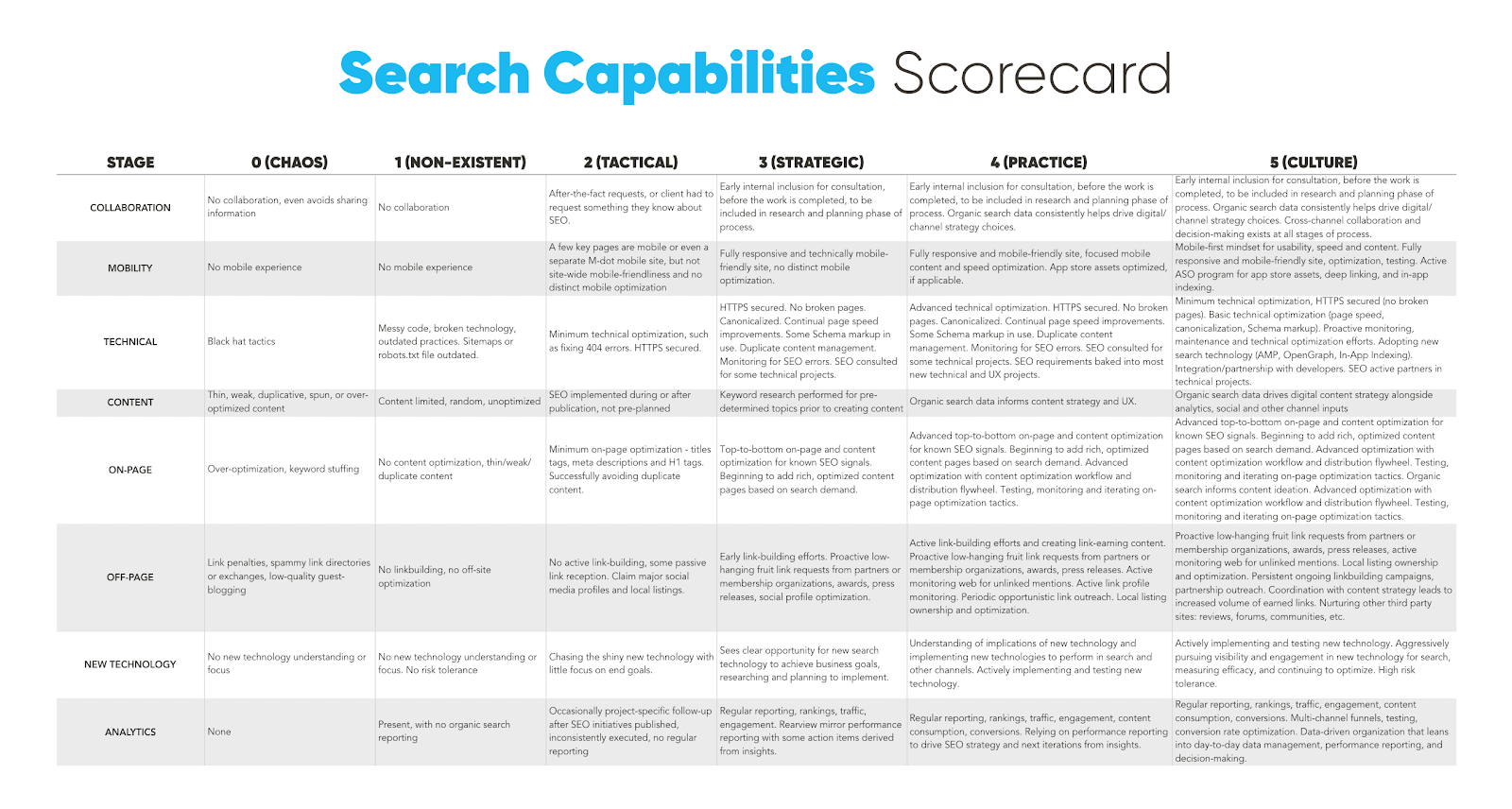
We measure an organization on several important criteria that contribute to the success of SEO:

  • Collaboration - how well relevant stakeholders integrate and collaborate to do the best work possible, including inside the organization, and between the organization and the service providers.
  • Mobility - how mobile-friendly and optimized the brand is.
  • Technical - how consistently foundational technical best practices are implemented and maintained.
  • Content - how integrated organic search is into the digital content marketing practice and process.
  • On-page - how limited or extensive on-page optimization is for the brand’s content.
  • Off-page - the breadth and depth of the brand’s off-site optimization, including link-building, local listings, social profiles and other non-site assets.
  • New technology -the appetite for and adoption of new technology that impacts search, such as voice search, AMP, even structured data.
  • Analytics - how data-centric the organization is, ranging from not managed and measured at all, to rearview mirror performance reporting, to entirely data-driven in search decision-making.

Search Capabilities Score Card

Click the image to see the full-size version.

SEO capabilities maturity stages

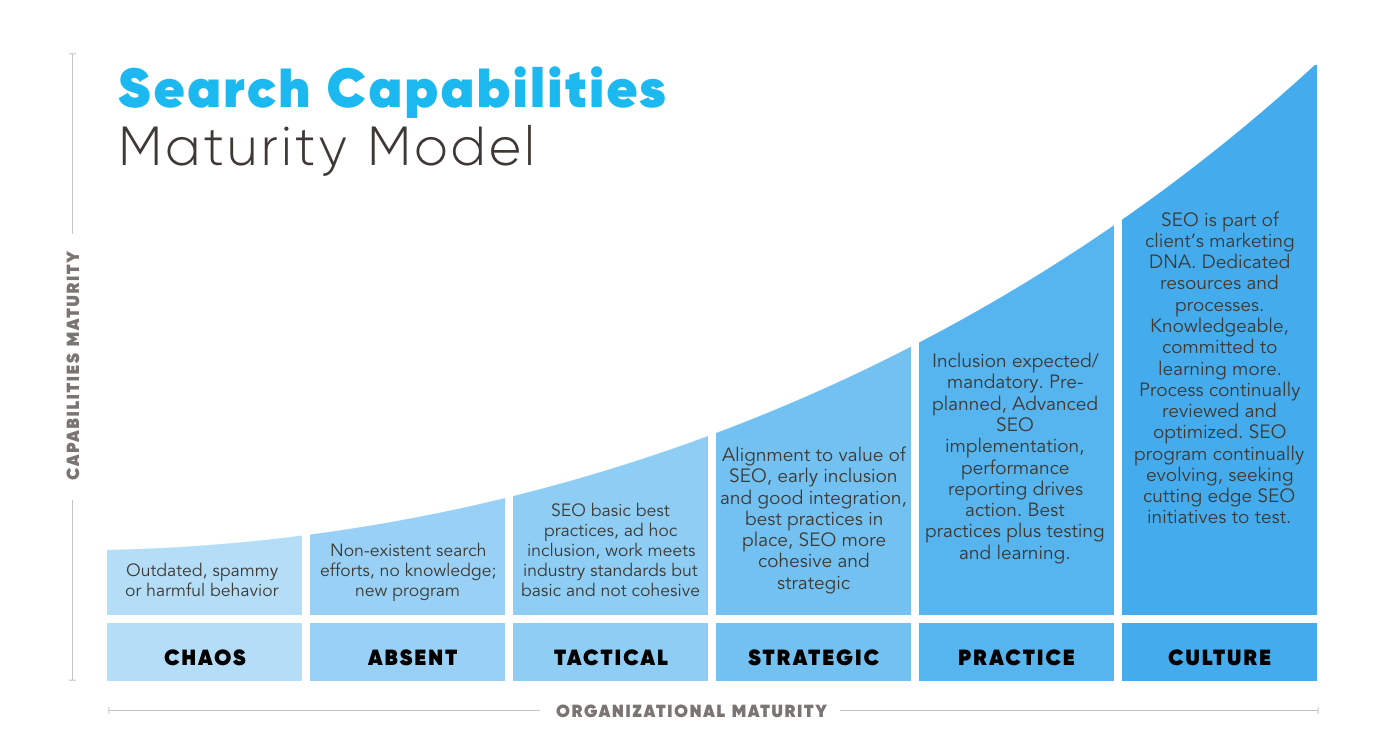
We assign each of the aforementioned criteria to one of these stages:

  • Stage 0 (Counterproductive) - The client is engaging in harmful or damaging SEO practices.
  • Stage 1 (Nonexistent) - There is no discernible SEO strategy or tactical implementation, and search is an all-new program for the client.
  • Stage 2 (Tactical) - The client may be doing some basic SEO best practices, but it tends to be ad hoc inclusion with little structure or pre-planning. The skills and the work meet minimum industry standards, but work is fairly basic and perhaps not cohesive.
  • Stage 3 (Strategic) - The client is aligned to the value of SEO, and makes an effort to dedicate resources to implementing best practices and staying current, as well as bake it into key initiatives. Search implementation is more cohesive and strategic.
  • Stage 4 (Practice) - Inclusion of SEO is an expectation for most of the client’s marketing initiatives, if not mandatory. They are not only implementing basic best practices but actively testing and iterating new techniques to improve their search presence. They use performance of past initiatives to drive next steps.
  • Stage 5 (Culture) - At this stage, clients are operating as if SEO is part of their marketing DNA. They have resources and processes in place, and they are knowledgeable and committed to learning more, their processes are continually reviewed and optimized, and their SEO program is evolving as the industry evolves. They are seeking cutting-edge new SEO opportunities to test.

Search Capabilities Maturity Model

Click the image to see the full-size version.

While this maturity model has been peer reviewed by a number of respected SEO peers in the industry (special thanks to Kim Jones at Seer Interactive, Stephanie Briggs at Briggsby, John Doherty at Credo, Dan Shure at Evolving SEO, and Blake Denman at Rickety Roo for your time and expertise), it is a fluid, living document designed to evolve as our industry does. If necessary, evolve this to your own reality as well.

You can download a Google Sheets copy of this maturity model here to begin using it with your client.

Download the maturity model

Why Stage 0?

In this search capabilities maturity model, I added an unconventional “Stage 0 - Counterproductive,” because organic search is unique in that they could do real damage and be at a deficit, not just at a baseline of zero.

In a scenario like this, the client has no collaboration inside the company or with the partner agency to do smart search work. Content may be thin, weak, duplicative, spun, or over-optimized. Perhaps their mobile experience is nonexistent or very poor. Maybe they’re even engaging in black hat SEO practices, and they have link-related or other penalties.

Choosing projects based on a client’s capabilities maturity

For a client that is starting on the lower end of the maturity scale, you may not recommend starting with advanced work like AMP and visual search technology, or even detailed Schema markup or extensive targeted link-building campaigns. You may have to start with the basics like securing the site, cleaning up information architecture, and fixing title tags and meta descriptions.

For a client that is starting on the higher end of the maturity scale, you wouldn’t want to waste their time recommending the basics — they’ve probably already done them. You"re better off finding new and innovative opportunities to do great search work they haven’t already mastered.

But we’re just getting started...

But technical capabilities and knowledge are only beginning to scratch the surface with clients. This starts to solve for what you should implement, but doesn’t touch why it’s so hard to get your work implemented. The real problems tend to be a lot squishier, and aren’t so simple as checking some SEO best practices boxes.

How mature is your client’s search practice?

The real challenges to implementation tend to be organizational, people, integration, and process problems. Conducting a search maturity assessment with your client can be eye-opening as to what needs to be solved internally before great search work can be implemented and start reaping the rewards. Pair this with the technical capabilities maturity model above, and you have a powerhouse of knowledge and tools to help your client.

Before we dig in, I want to note one important caveat: While this maturity model focuses heavily on organizational adoption and process, I don’t want to suggest that process and procedure are substitutes for using your actual brain. You still have to think critically and make hard choices when you execute a best-in-class search program, and often that requires solving all-new problems that didn’t exist before and therefore don’t have a formal process.

Search practice maturity criteria

We measure an organization on several important criteria that contribute to the success of SEO:

  • Process, policy, or procedure - Do documented, repeatable processes for inclusion of organic search exist, and are they continually improving? Is it an organizational policy to include organic search in marketing efforts? This can mean that the process of including organic search in marketing initiatives is defined as a clear series of actions or steps taken, including both developing organic search strategy and implementing SEO tactics.
  • Personnel resources & integration - Does the necessary talent exist at the organization or within the service provider’s scope? Personnel resources may include SEO professionals, as well as support staff such as developers, data analysts, and copywriters necessary to implement organic search successfully. Active resources may work independently in a disjointed manner or collaboratively in an integrated manner.
  • Knowledge & learning - Because search is a constantly evolving field, is the organization knowledgeable about search and committed to continuously learning? Information can include existing knowledge, past experience, or training in organic search strategy and tactics. It can also include a commitment to learning more, possibly through willingness to undertake trainings, attendance of conferences, regular consumption of learning materials, or staying current in industry news and trends.
  • Means, capacity, & capabilities - Does the organization budget appropriately for and prioritize the organic search program? Means, capacity and capabilities can include being scoped into a client contract, adequate budget being allocated to the work, adequate human resources being allocated to the work, the capacity to complete the work when measured against competing demands, and the prioritization of search work alongside competing demands.
  • Planning & preparation - Is organic search aligned to business goals, brand goals, and/or campaign goals? Is organic search proactively planned, reactive, or not included at all? This measure evaluates how frequently organic search efforts are included in marketing efforts for a brand. It also measures how frequently the work is included proactively and pre-planned, as opposed to reactively as an afterthought. Work may be aligned to or disconnected from the "big picture."

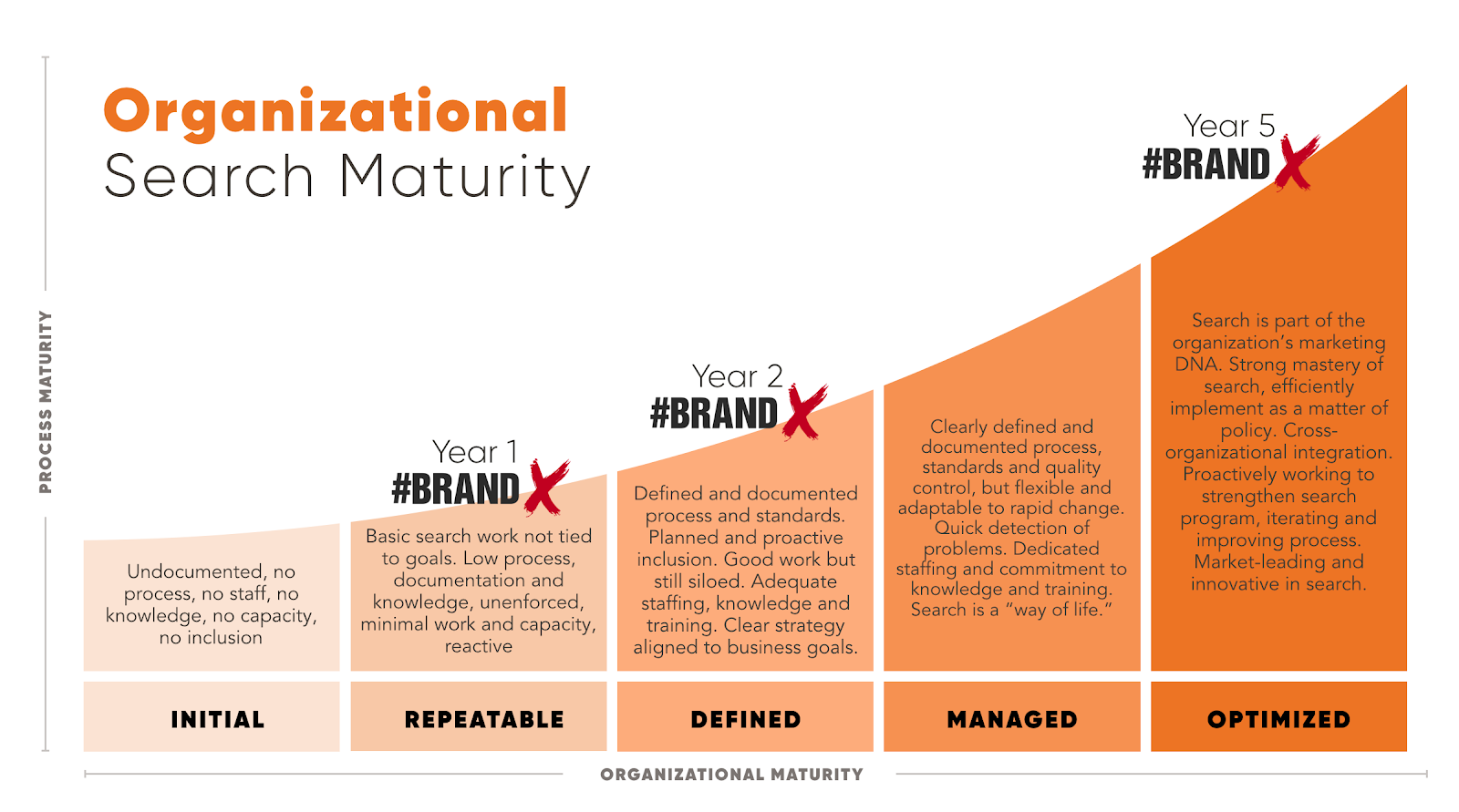
Organizational search maturity

Click the image to see the full-size version.

Search practice stages of maturity

Stage 1 - Initial & ad hoc

At this stage, the organizations’ search application may be nonexistent, unstable, or uncontrolled. There may be rare and small SEO efforts, but they are entirely ad hoc and inconsistent, and retrofitted to the work after the fact, at best. They tend to lack any discernible goal orientation. If SEO exists, it is disconnected from larger goals, and not integrated with any other practices across the organization. They may be just beginning their search practice for the first time.

Stage 2 - Repeatable but reactive

These organizations are at least doing some search basics, though there is no rigorous use or enforcement of it. It is very reactive and in-the-moment while projects are being implemented; it is rarely pre-planned and often SEO is applied as an afterthought. They are executing only in the present or when it’s too late to do the highest caliber search work, but they are making an effort. SEO efforts may occasionally be going after goals, but it is unlikely to be tied to larger business goals. (Most of my client relationships have started here.)

Stage 3 - Defined & understood

These organizations have started to document their processes and are satisfactorily knowledgeable and competent in search. They have minimum standards for search best practices and process is emerging. Many people inside and outside the organization understand that search is important and are taking steps to integrate. There is a clear search strategy that aligns to organizational goals and processes. Proactive search preparation and planning happens prior to activating projects.

Stage 4 - Managed & capable

These organizations have proactive, predictable implementation of search work. They have quality-focused rules for products and processes, and can quickly detect and correct missteps. They have clearly defined processes for integration, implementation and oversight, but are flexible enough to adapt to a range of conditions without sacrificing quality. These organizations consider search part of their “way of life.”

Stage 5 - Efficient & optimizing

Organizations at this stage have a strong mastery of search and efficiently implementing as a matter of policy. They have cross-organizational integration and proactively work to strengthen their search performance. They are always improving the process through incremental or innovative change. They review and analyze their process and implementation to keep optimizing. These organizations could potentially be considered market-leading or innovative.

Scorecard exercise

Click the image to see the full-size version.

You are here

Before you can know how to get where you want to go, you need to know where you are. It"s important to understand where the organization stands, and then where they need to be in the future. Going through the quantitative exercise of diagnosing their maturity can help everyone align to where to start.

You can use these scorecards to assess factors like leadership alignment to the value of search, employee availability and involvement, knowledge and training, process and standardization, their culture (or lack thereof) of data-driven problem-solving and continuous improvement, and even budget.

A collaborative exercise

This should be a deeper exercise than just punching numbers into a spreadsheet, and it certainly shouldn’t be a one-sided assessment from you as an outsider. It is much more valuable to ask several relevant people at multiple levels across the client organization to participate in this exercise, and can become much richer if you take the time to talk to people at various points in the process.

How to use the scorecard & diagnose maturity

Once you download the scorecards, follow these steps to begin the maturity assessment process.

  1. Client-side distribution - Distribute surveys to relevant stakeholders on the client"s internal team. Ideally, these individuals serve at a variety of levels at the company and occupy a mix of roles relevant to the organic search practice. These could include CEO, CMO, Marketing VPs and directors, digital marketing coordinators, and in-house SEOs.
  2. Agency-side distribution - Distribute surveys to relevant stakeholders on the agency team. Ideally, these individuals serve at a variety of levels at the agency and occupy a mix of roles relevant to the organic search practice. These could include digital marketing coordinators, client engagement specialists, analysts, digital copywriters, or SEO practitioners.
  3. Assign a level of maturity to each criteria - Each survey participant can simply mark one "X" per category row in the column that most accurately reflects perception of the brand organization as it pertains to organic search. (For example, if the survey respondent feels that SEO process and procedure are non-existent based on the description, they can mark an “X” in the “Initial/Ad Hoc” column. Alternatively, if they feel they are extraordinarily advanced and efficient in their processes, they may mark the “X” in the “Efficient & Optimizing” column.)
  4. Collect the surveys - Assign a point value of 1, 2, 3, 4, or 5 to the responses from left to right in the scorecard. Average the points to get a final score for each. (For example, if five client stakeholders score their SEO process and procedure as 3, 4, 2, 3, 3 respectively, the average score is 3 for that criteria.)
  5. Comparing client to agency perception - You may also choose to ask survey respondents to denote whether they are client-side or agency-side so you can look at the data both in aggregate, and by client and agency separately, to determine if there is alignment or disagreement on where the brand falls on the maturity curve. This can be great material for discussion with the client that can open up conversations about why those differences in perception exist.

Screenshot of scorecard

To get your own scorecard, click the image and make a copy of the Google Sheet.

Choosing where to start

The goal is to identify together where to start working. This means finding the strengths to capitalize upon, areas of acceptability that can be nudged to a strength with a little work, weaknesses to improve upon, agreeing on areas to focus, and finally, how to get started tackling the first change together.

For a client that is starting on the low end of the maturity scale, it is unrealistic to expect that they have connected all the dots between important stakeholders, that they have a clearly defined and repeatable process, and that their search program is a well-oiled machine. If you don’t work together to solve the underlying problems like knowledge or adequate personnel resources first, you will struggle to get buy-in for the work or the resources to get it done, so it doesn’t matter what projects you recommend.

For a client that is advanced in a few areas, say process, planning, and capacity, but weaker in others like knowledge and capacity, that might suggest that you need to focus efforts on an education campaign to help the client prioritize the work and fit it into a busy queue.

For a client that is already advanced across the board, your role instead may be to keep the machine running while also helping them spot minor areas of improvement so they can keep iterating and perfecting the process. This client might also be ready for more advanced search strategies and tactical recommendations, or perhaps more robust integrations across additional disciplines.

One foot in front of the other

It’s rare that we live in a world of radical change where we overhaul everything en masse and see epic change overnight. We tweak, test, learn, and iterate. A maturity model is a continuum, and brands must evolve from one step to the next. Skipping levels is not an option. Some may also call this a “crawl, walk, run” approach.

Your goal as their trusted search advisor is not to help them leap from Stage 2 to Stage 5. Accomplishing that trajectory and speed of growth is exceedingly difficult and rare. Instead, focus your efforts on how the client can get to the next stage over the next 12 months. As they progress up the maturity model, the length of time it takes to unlock the next level may grow longer and longer.

Organizational Search Maturity

Click the image to see the full-size version.

Even when an organization reaches Stage 5, your/their work is not done. Master-level organizations continue to refine and optimize their processes and capabilities.

There is no finish line to search maturity

There is a French culinary phrase, “mise en place,” that refers to having everything — ingredients, tools, recipe — in its place to begin cooking most successfully. There are several key ingredients to any successful project implementation: buy-in, process, knowledge and skills, capacity, planning, and more.

As your client evolves up the maturity curve, you will see and feel a transition from thinking about aspects only once a project is sliding off the rails, to including these things real-time and reactively, to anticipating these before every project and doing your due diligence to come prepared. Essentially, the client can move from not being able to spell “SEO” to making SEO a part of their DNA by moving up these maturity curves.

It is important to revisit the maturity model discussion periodically — I recommend doing so at least annually — to level-set and realign with the client. Conducting this exercise again can remind us to pause and reflect on all we have accomplished since the first scoring. It can also re-energize stakeholders to make even more progress in the upcoming year.


Sign up for The Moz Top 10, a semimonthly mailer updating you on the top ten hottest pieces of SEO news, tips, and rad links uncovered by the Moz team. Think of it as your exclusive digest of stuff you don"t have time to hunt down but want to read!

The Moz Blog

Keyword Stuffing Will Not Cause Sites to be Removed from Google

Keyword stuffing is an SEO trick that dates back many, many years – predating Google – and it is still periodically seen by sites that are ranking well in the search results.  But how bad is it to do it on a site? The question came up on Twitter and John Mueller from Google clarified […]

The post Keyword Stuffing Will Not Cause Sites to be Removed from Google appeared first on The SEM Post.


The SEM Post

Sunday, 1 July 2018

The Content Marketer’s Workflow: 6 Steps to Get Your Content Visible Online

A strong content strategy isn

It takes time to create great content: you brainstorm, research, design and redesign, brand, edit, and optimize. After a brief flurry of traffic from your distribution channels, there’s a problem: your content goes quiet. As soon as you stop actively promoting it, people stop finding it.

It’s exhausting and the results are erratic when you depend on short spikes of traffic to drive your content strategy. On the other hand, if you have just one piece of content that ranks well in organic search, over time it delivers 10x more value than the rest of your content marketing plan combined.

You already create great content, you just need your customers to see it. This workflow can help:

6-Step Content Strategy Workflow

  1. Research topics: Identify the trends and topics that are in demand.
  2. Analyze type: Know what content format will resonate best.
  3. Map content: Target buyer personas along the customer journey.
  4. Optimize: Improve the content you have to maximize ROI.
  5. Configure site: Segment, compare, and measure your content.
  6. Report: Create reports to share your success.


Step 1: Identify the trends and topics that your customers are searching for so you create content that’s in demand

Come up with an initial list of topics with your team, and then use a keyword research tool to decide which topics will resonate best with your audience. Look at:

  • Search volume – Find high search volume terms that are relevant to your topics. Select a cluster of related terms for each individual topic.
  • Search intent – Determine whether searchers are looking for early (educational), mid (exploring solutions), or late stage (transactional) content along the customer journey.
  • Competition – High page authority results in the top positions and stagnant results (they don’t change much week to week) indicate difficulty.

Tip: Which keyword would you choose — term A with 10,000 MSV or term B with 1,000 MSV? Term A, right? Not so fast!
A Keyword Research Tool can help you think in terms of clusters: you might find there are 100 related terms for B and only 5 related terms for A. So the math means the potential reach for A: 10×5=50,000 MSV. The potential reach for B: 1×100=100,000 MSV) If you are looking for volume, B is the better choice.

Content Strategy Spotlight: JanSport

“We used to call one of our products a “digital bag” in our content. Our keyword research showed us that consumers didn’t know what a “digital bag” was or think about our products that way.

The fact is: you can have an amazing product that people love, but if no one can find it online, you won’t drive interest or traffic.” –Victoria Reuter, JanSport [read full story]

Adjusting your content strategy to capture your customer

Step 2: Know what type of content — like videos, articles, or images – will resonate most with your audience

Now that you have your topics, decide what format your content should take. Search for the terms you found in step one, and look at the content formats that appear on the search engine results pages (SERPS) for your topics. You’ll see formats like:

Google now includes multiple different types of search results; build your content strategy accordingly.

Manually search, or use your content and SEO platform to see how those formats vary across search locations and devices.

Go ahead and click through on the top ranking results to get a better understanding of your competitors’ content and page structure. (Model your content after the top rankers but do it better.)

Content Strategy Spotlight: Birchbox


Your position on the SERP for a specific type of universal search result can heavily impact your content strategy.

“Our Beauty Essentials series takes a simple, educational approach, teaching basic beauty skills. The products are secondary. The topics are SEO-friendly, so organic search has been a huge driver. It consistently gets great engagement and great sentiment.”
-Lorelei Orfeo, Birchbox [Read full story]

Step 3: Create the right content for the right customer at the right stage of the customer journey

It’s time to think about how the content you’re creating will fit into your overall content strategy. Content mapping will help you accomplish two things:

  • Complement the assets you have. Fill gaps instead of creating redundant content.
  • Get qualified traffic, not just any traffic. Map your content to the right customer when they’re looking for it.

Categorize your content by buyer’s persona and customer journey stage. Tackle your whole site or just take on a section, campaign, or product. If you don’t have content mapping technology, use an excel sheet to track your urls.

When you have created a content map, you’ll be able to see cracks in your content strategy. Look for opportunities to create content where you’re not visible, or optimize content that’s visible but not converting.

Content Strategy Spotlight: Sealed Air

Mapping your content across the stages of the customer journey and customer personas can help you identify gaps in your content strategy.

“As the world gets more sophisticated, we need to produce the right content for the right person at the right time. And Searchlight’s Content Mapping feature allows us to map out our buyer personas and journeys. With it, we see content and keyword gaps.” –Ben Pollack, Sealed Air [read full story]

Step 4: Optimize the content you have to maximize ROI

As content marketers, we can get swept up in the frenzy of creating new content and rarely revisit what’s already on our site. But improving the assets you have is critical – you can get big payoffs for a small amount of work.

You have access to change a few things in your source code, like title tags, meta description, H1 tags, and body content.

Titles and Meta Descriptions help convey to Google what your page is about, and also help entice searchers (who see your result snippet) to click on you.

Add keywords and details to your calls-to-action (“Red Cars” vs “Red Convertible Cars”) or Meta Descriptions (“We have the best red cars.” vs “We have the best red cars and have $ 0 APR for 24 months”)

You can also optimize your image titles, alt tags, url, and body copy with keywords.

Headers, alt text, and the URL are important parts of a content strategy.Ultimately, optimizations are an experiment. There’s no one right way. Here are some experiments you may want to try to increase your conversions and rankings:

  • Freshen and improve the quality of that content to better fit buyer personas and customer journey stage (look at user intent)
  • Break up large pieces of content into focused, small pieces
  • Combine small pieces into a larger piece, redirecting existing posts to strengthen the authority of a single page
  • Improve your internal linking structure to add authority – have high-authority pages point links to the page you want to rank
  • Implement A/B testing and change up page elements like colors, fonts, images, and CTAs to see what converts best
  • Conduct social and link campaigns to get external signals to bolster the authority of existing pages

As you make changes, keep a record of what changes you’ve made for each page, and when (the easiest way to do this is to add and automate annotations in your content software).

Content Strategy Spotlight: Republic WirelessComparing your content ranking against your competition is key to developing a content strategy.“I wanted to optimize our wifi calling page, which is an extremely high competition search term. I expanded our page with related keywords and optimized the metadata. After we focused on optimizing that page, we’ve seen 108% more traffic, 100% more revenue, and 22% longer session duration.”
–Cody Gault, Republic Wireless [read full story]

Step 5: Segment, compare, and measure your content to see how well you’re performing

Configure your tracking technology (analytics or SEO platform) so you can quickly understand your content wins and losses.

Set up segments, groupings of pages, on meaningful parts of your business. Segment examples:

  • Product category (bedding pages, bathroom pages, etc.)
  • Sections of your site (company blog, learn center, product pages, free trial page, etc.)
  • Author (journalist A, freelancer B, employee C)

Set up categories, groupings of keywords, so you can see when you are visible for topics important to your strategy. Categories Examples:

  • Branded and non-branded (“Ikea lamp” vs. “best lamp for dorm room”)
  • Topics (Manufacturing, Packaging Solutions, Hygiene Products)

Content Strategy Spotlight: Madison Reed

Track your content results over time to note successes and help optimize past and future content.

“Setting up page segments and categories is time well spent. They highlight the problems and the victories we’re achieving with our content strategy. Every Monday, I look for big drops and gains in our segments and categories. I use that information to plan out high-impact activities like content creation and optimization.”
-Matthew Rogers, Madison Reed

Step 6: Create reports to share your success

Reports do two important things. They enable you to continuously improve your strategy and to communicate the impact you’ve had on your business to other parts of your organization. Reports can help you get more resources by showing the potential money and market share that’s on the table.

Think of reports in terms of questions you want to answer for your site:

  • Are we succeeding in creating or improving content that is visible for target keywords?
  • Are we hitting our targets for rank positions and traffic for those pages?
  • How is a particular new piece of content doing? Is it bringing in new organic traffic? How is it ranking for the keywords we are tracking?
  • Which of our writers brings in the most organic traffic? (Create segments based on writers to see these trends.)
  • What are our top 10 highest visited pages by organic, and overall?
  • Which keywords do our competitors rank for where we don’t?
  • How does our overall organic market share compare to our competitors?
  • Have we gained or dropped visibility or conversions for important pieces of content? (Pay special attention to movement to or from the first page of search engine, where the vast majority of clicks occur.)
  • If we had more resources to target more content opportunities, what ROI could we achieve?

Content Strategy Spotlight: Seer

Reporting on your results and tracking your content will help you continue to iterate your content strategy.

“Our workspaces (reports) cover a range of target areas for our clients, like search competition, content strategy analysis, and keyword research. They help inform decisions, create content for clients, encourage quicker arch updates and give us an idea of the competitive landscape.”
–Wil Reynolds, Seer [read full story]

The Content Strategy Workflow Golden Rule: Know What’s in Demand

If you take nothing else from this workflow, remember this: you will be more successful if you assess customer demand before you create content.

Second, don’t focus solely on creation. Spend time improving content you have – you’ll ultimately drive more value if you are resourceful with the content that’s already available to you.

Finally, carefully configure and measure your site, making sure you can understand the value of your work, and share it with others.

What’s your content marketing plan for organic search? How do you get your content visible online?

Want to see how you stack up against other content marketers? Download both B2B and B2C e-books and dig deeper into how content marketers strategize.

The post The Content Marketer’s Workflow: 6 Steps to Get Your Content Visible Online appeared first on Conductor Spotlight.


Conductor Spotlight

Daily Search Forum Recap: June 29, 2018

Here is a recap of what happened in the search forums today, through the eyes of the Search Engine Roundtable and other search forums on the web...

Search Engine Roundtable

The Content Marketer’s Workflow: 6 Steps to Get Your Content Visible Online

A strong content strategy isn

It takes time to create great content: you brainstorm, research, design and redesign, brand, edit, and optimize. After a brief flurry of traffic from your distribution channels, there’s a problem: your content goes quiet. As soon as you stop actively promoting it, people stop finding it.

It’s exhausting and the results are erratic when you depend on short spikes of traffic to drive your content strategy. On the other hand, if you have just one piece of content that ranks well in organic search, over time it delivers 10x more value than the rest of your content marketing plan combined.

You already create great content, you just need your customers to see it. This workflow can help:

6-Step Content Strategy Workflow

  1. Research topics: Identify the trends and topics that are in demand.
  2. Analyze type: Know what content format will resonate best.
  3. Map content: Target buyer personas along the customer journey.
  4. Optimize: Improve the content you have to maximize ROI.
  5. Configure site: Segment, compare, and measure your content.
  6. Report: Create reports to share your success.


Step 1: Identify the trends and topics that your customers are searching for so you create content that’s in demand

Come up with an initial list of topics with your team, and then use a keyword research tool to decide which topics will resonate best with your audience. Look at:

  • Search volume – Find high search volume terms that are relevant to your topics. Select a cluster of related terms for each individual topic.
  • Search intent – Determine whether searchers are looking for early (educational), mid (exploring solutions), or late stage (transactional) content along the customer journey.
  • Competition – High page authority results in the top positions and stagnant results (they don’t change much week to week) indicate difficulty.

Tip: Which keyword would you choose — term A with 10,000 MSV or term B with 1,000 MSV? Term A, right? Not so fast!
A Keyword Research Tool can help you think in terms of clusters: you might find there are 100 related terms for B and only 5 related terms for A. So the math means the potential reach for A: 10×5=50,000 MSV. The potential reach for B: 1×100=100,000 MSV) If you are looking for volume, B is the better choice.

Content Strategy Spotlight: JanSport

“We used to call one of our products a “digital bag” in our content. Our keyword research showed us that consumers didn’t know what a “digital bag” was or think about our products that way.

The fact is: you can have an amazing product that people love, but if no one can find it online, you won’t drive interest or traffic.” –Victoria Reuter, JanSport [read full story]

Adjusting your content strategy to capture your customer

Step 2: Know what type of content — like videos, articles, or images – will resonate most with your audience

Now that you have your topics, decide what format your content should take. Search for the terms you found in step one, and look at the content formats that appear on the search engine results pages (SERPS) for your topics. You’ll see formats like:

Google now includes multiple different types of search results; build your content strategy accordingly.

Manually search, or use your content and SEO platform to see how those formats vary across search locations and devices.

Go ahead and click through on the top ranking results to get a better understanding of your competitors’ content and page structure. (Model your content after the top rankers but do it better.)

Content Strategy Spotlight: Birchbox


Your position on the SERP for a specific type of universal search result can heavily impact your content strategy.

“Our Beauty Essentials series takes a simple, educational approach, teaching basic beauty skills. The products are secondary. The topics are SEO-friendly, so organic search has been a huge driver. It consistently gets great engagement and great sentiment.”
-Lorelei Orfeo, Birchbox [Read full story]

Step 3: Create the right content for the right customer at the right stage of the customer journey

It’s time to think about how the content you’re creating will fit into your overall content strategy. Content mapping will help you accomplish two things:

  • Complement the assets you have. Fill gaps instead of creating redundant content.
  • Get qualified traffic, not just any traffic. Map your content to the right customer when they’re looking for it.

Categorize your content by buyer’s persona and customer journey stage. Tackle your whole site or just take on a section, campaign, or product. If you don’t have content mapping technology, use an excel sheet to track your urls.

When you have created a content map, you’ll be able to see cracks in your content strategy. Look for opportunities to create content where you’re not visible, or optimize content that’s visible but not converting.

Content Strategy Spotlight: Sealed Air

Mapping your content across the stages of the customer journey and customer personas can help you identify gaps in your content strategy.

“As the world gets more sophisticated, we need to produce the right content for the right person at the right time. And Searchlight’s Content Mapping feature allows us to map out our buyer personas and journeys. With it, we see content and keyword gaps.” –Ben Pollack, Sealed Air [read full story]

Step 4: Optimize the content you have to maximize ROI

As content marketers, we can get swept up in the frenzy of creating new content and rarely revisit what’s already on our site. But improving the assets you have is critical – you can get big payoffs for a small amount of work.

You have access to change a few things in your source code, like title tags, meta description, H1 tags, and body content.

Titles and Meta Descriptions help convey to Google what your page is about, and also help entice searchers (who see your result snippet) to click on you.

Add keywords and details to your calls-to-action (“Red Cars” vs “Red Convertible Cars”) or Meta Descriptions (“We have the best red cars.” vs “We have the best red cars and have $ 0 APR for 24 months”)

You can also optimize your image titles, alt tags, url, and body copy with keywords.

Headers, alt text, and the URL are important parts of a content strategy.Ultimately, optimizations are an experiment. There’s no one right way. Here are some experiments you may want to try to increase your conversions and rankings:

  • Freshen and improve the quality of that content to better fit buyer personas and customer journey stage (look at user intent)
  • Break up large pieces of content into focused, small pieces
  • Combine small pieces into a larger piece, redirecting existing posts to strengthen the authority of a single page
  • Improve your internal linking structure to add authority – have high-authority pages point links to the page you want to rank
  • Implement A/B testing and change up page elements like colors, fonts, images, and CTAs to see what converts best
  • Conduct social and link campaigns to get external signals to bolster the authority of existing pages

As you make changes, keep a record of what changes you’ve made for each page, and when (the easiest way to do this is to add and automate annotations in your content software).

Content Strategy Spotlight: Republic WirelessComparing your content ranking against your competition is key to developing a content strategy.“I wanted to optimize our wifi calling page, which is an extremely high competition search term. I expanded our page with related keywords and optimized the metadata. After we focused on optimizing that page, we’ve seen 108% more traffic, 100% more revenue, and 22% longer session duration.”
–Cody Gault, Republic Wireless [read full story]

Step 5: Segment, compare, and measure your content to see how well you’re performing

Configure your tracking technology (analytics or SEO platform) so you can quickly understand your content wins and losses.

Set up segments, groupings of pages, on meaningful parts of your business. Segment examples:

  • Product category (bedding pages, bathroom pages, etc.)
  • Sections of your site (company blog, learn center, product pages, free trial page, etc.)
  • Author (journalist A, freelancer B, employee C)

Set up categories, groupings of keywords, so you can see when you are visible for topics important to your strategy. Categories Examples:

  • Branded and non-branded (“Ikea lamp” vs. “best lamp for dorm room”)
  • Topics (Manufacturing, Packaging Solutions, Hygiene Products)

Content Strategy Spotlight: Madison Reed

Track your content results over time to note successes and help optimize past and future content.

“Setting up page segments and categories is time well spent. They highlight the problems and the victories we’re achieving with our content strategy. Every Monday, I look for big drops and gains in our segments and categories. I use that information to plan out high-impact activities like content creation and optimization.”
-Matthew Rogers, Madison Reed

Step 6: Create reports to share your success

Reports do two important things. They enable you to continuously improve your strategy and to communicate the impact you’ve had on your business to other parts of your organization. Reports can help you get more resources by showing the potential money and market share that’s on the table.

Think of reports in terms of questions you want to answer for your site:

  • Are we succeeding in creating or improving content that is visible for target keywords?
  • Are we hitting our targets for rank positions and traffic for those pages?
  • How is a particular new piece of content doing? Is it bringing in new organic traffic? How is it ranking for the keywords we are tracking?
  • Which of our writers brings in the most organic traffic? (Create segments based on writers to see these trends.)
  • What are our top 10 highest visited pages by organic, and overall?
  • Which keywords do our competitors rank for where we don’t?
  • How does our overall organic market share compare to our competitors?
  • Have we gained or dropped visibility or conversions for important pieces of content? (Pay special attention to movement to or from the first page of search engine, where the vast majority of clicks occur.)
  • If we had more resources to target more content opportunities, what ROI could we achieve?

Content Strategy Spotlight: Seer

Reporting on your results and tracking your content will help you continue to iterate your content strategy.

“Our workspaces (reports) cover a range of target areas for our clients, like search competition, content strategy analysis, and keyword research. They help inform decisions, create content for clients, encourage quicker arch updates and give us an idea of the competitive landscape.”
–Wil Reynolds, Seer [read full story]

The Content Strategy Workflow Golden Rule: Know What’s in Demand

If you take nothing else from this workflow, remember this: you will be more successful if you assess customer demand before you create content.

Second, don’t focus solely on creation. Spend time improving content you have – you’ll ultimately drive more value if you are resourceful with the content that’s already available to you.

Finally, carefully configure and measure your site, making sure you can understand the value of your work, and share it with others.

What’s your content marketing plan for organic search? How do you get your content visible online?

Want to see how you stack up against other content marketers? Download both B2B and B2C e-books and dig deeper into how content marketers strategize.

The post The Content Marketer’s Workflow: 6 Steps to Get Your Content Visible Online appeared first on Conductor Spotlight.


Conductor Spotlight