

Sure it was only three years ago (almost to the day), but my how the landscape has changed.
In 2013, to get to the top of Google it was merely a manner of doing some killer keyword research, ensuring your site had a good and clear structure and making sure you had a ton of high authority backlinks coming your way.
And although these are all still very relevant practices today, we also now have to contend with these brand new factors too…
Disclaimer: there are hundreds of things you need to do to improve search visibility, this is a list concentrating on the more recent developments.
1) Optimise for RankBrain
RankBrain is Google’s machine-learning AI system, which has been revealed by Google to one of thetop three ranking signals in its vast array of contributing factors.
Google uses RankBrain to handle ambiguous or unique questions that have never been asked before. Brand new queries make up to 15% of all searches a day – and as Google processes 3bn searches daily – this means that 450m searches a day are entirely unique.
Machine learning is clearly necessary to cope with this huge demand, and for search marketers it may be difficult to truly optimise for.
However according to our recent post on how to optimise content for RankBrain, you can do so in a number of ways, the most important being… Create content that answers unique queries that are particularly relevant to your audience personas.
This will take time, research and a little trial & error, but with enough references and supporting information in your clearly formatted, long-form content, you may start to see more visibility for relevant queries.
2) Optimise for ‘near me’ search queries
According to Google, ’micro-moments’ are the “critical touch points within today’s consumer journey, and when added together, they ultimately determine how that journey ends.”
This basically points to mobile as being the key driver for local search, and how essentially you should be optimising for exactly that.
As Chris Lake mentions in his post on optimising for micro-moments, mobile searchers are a) very active and b) not brand loyal, so there’s a huge opportunity, especially as many businesses are lagging behind due to poor mobile user experiences.
The advice here is to be all about anticipation, relevance and ease of use…

3) Optimise your local presence
Following on from the last point, it’s no good optimising for ‘near me’ search queries if you’re not actually ‘there’. So you need to sort out your local SEO.
You can do this by optimising your Google My Business page. Among many others things, you’ll need to make sure you have the following features…
- A long and unique description of your business.
- Choose the right categories.
- Key information on opening times.
- Lots of imagery.
- Regular updates.
- A local phone number and business address.
And one of the other major local SEO factors is making sure you have lots of visible customer reviews, which as Graham Charlton states are “vital for local businesses, whether or not they sell online, thanks to their sheer prominence in local search results.”
4) Optimise for natural language and voice search
In Mary Meeker’s 2016 Internet Trends report, it states that Google Voice Search queries have risen 35x since 2008.
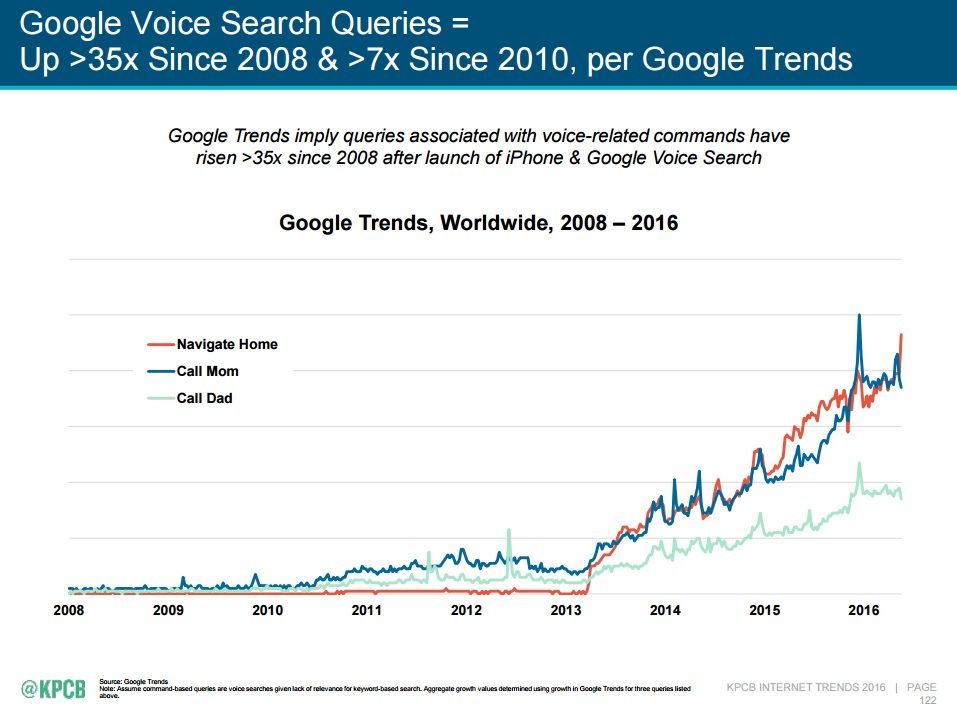
Why this explosion in voice search? Voice input is 4x faster than typing, you will therefore have access to faster results. There are obvious accessibility issues. People have difficulty typing on certain devices. People also like to avoid confusing menus. Ultimately no matter how mobile-optimised a site is, or how big our phones are getting, searching on a mobile is still damn fiddly.
Google has worked hard to improve its search engine so it can better understand superlatives, ordered items, points in time and complex combinations.
The key to optimising for voice search therefore is to provide content for more direct questions. Those that are spoken in a far more natural language than the one we normally use when typing into a search engine, where keywords are dominant.
5) Answer a question
Following on from optimising for natural language is being able to directly answer questions with your content.
Google scrapes third party websites in order to present searchers with a clear on-SERP answer to their more ‘knowledge-based queries’ (when is Kanye West’s birthday? etc). Although Wikipedia used to be the dominant site in these answer boxes, this is becoming less so as Google recognises that more quality expert content is coming from other publishers.
So find out what questions your site can answer and create content that does exactly that. It will help if you’re as succinct as possible, you phrase the question in the headline and you answer the question as soon in the article as possible.
6) Pay for it
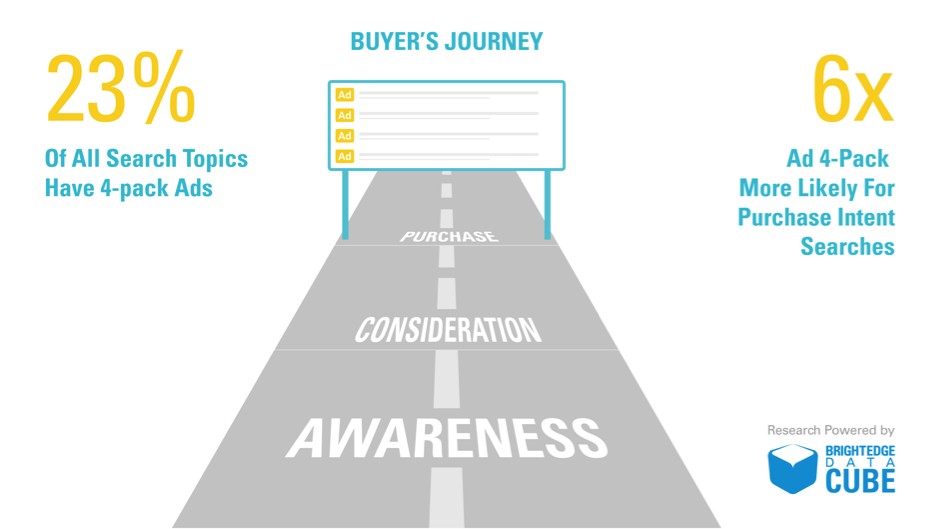
Some things are still very much a truism now as they were in 2013… You can just ignore all of these tips just by paying your way to the top with PPC ads.
Although you will still need quality ad copy, relevant landing pages and high customer rated products (especially if your entering into the Product Listing Ads space), but yes, you can still throw money at the problem.
However, here we’ll tell you why your ads don’t necessarily need to come first in the new look SERPsanymore.
7) Get in Top Stories, implement AMP
Getting your site into Google News has always been a sure fire way to drive short-term traffic to your content.
It’s not great for evergreen appeal, but if you can be hot off the presses with good quality news stories than it can also be great for other sites linking to you as a source.
Top Stories is the mobile equivalent of the desktop In the News section, and right now this section is filling up with Accelerated Mobile Pages (AMP). AMP is Google’s open-source program that allows webmasters the ability to create super-quick, stripped-down, instantly loading versions of web-pages for mobile users.
AMP isn’t a ranking signal yet, but if you’re appearing in Top Stories than having AMP pages will help improve user experience. Here’s a tutorial on how to implement AMP successfully.
Also note that AMP results will be appearing throughout the mobile SERP by the end of the year.
8) Be mobile optimised
You should have this nailed by now. Although three years ago many of you didn’t, and back then it wasn’t a ranking signal. It is now though!
But to help you out, we’ve published this massive and comprehensive guide to testing the mobile usability of your site. You’re welcome.
9) Speed up your website
As I mentioned earlier, AMP is certainly helping to speed up the mobile web. Although it is controversial in nature, and isn’t necessarily the best solution to improving the speed of websites in general as it just feels like a ‘quick fix’.
You do still need to prioritise the speed of your actual site, not just grafting on Google-owned patches. Site speed is a ranking factor, but there are many ways you can improve performance.
First, check your site speed using this tool and then you can access a report breaking-down where you can improve.
You can also make a huge difference in reducing page load by following these image optimisation tips for site speed.
10) Optimise your Twitter presence
Although this may be the final tip in this list, it’s obviously not the last thing you can optimise to get to the top of Google. However one major change to the SERP in the last few years has been the introduction of tweets.
Last year, thanks to a deal between Twitter and Google, tweets are now indexed on SERPs. So if you search for a brand, publisher or personality, you will now see a live timeline of their latest tweets.
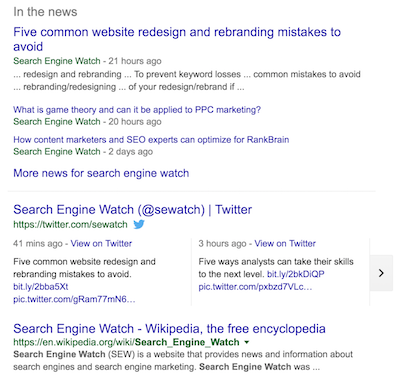
So make sure you tweet regularly, have a fairly substantial following and for goodness sake don’t say anything you’ll regret because it will probably remain cached for a couple of hours.

No comments:
Post a Comment